
Delegated Regulation (EU) 2026/110 has resolved the critical open question in the FASTER Directive: which EU member states must operate under the new fast-track withholding tax framework, and which can stay outside it. The answer will define the operational landscape for institutional investors and custodians from 1 January 2030 onwards.
Why This Regulation Matters
The FASTER Directive (Council Directive (EU) 2025/50) is the most far-reaching reform to EU withholding tax procedures in a generation. It introduces a digital tax residence certificate (eTRC), two standardised fast-track relief procedures (relief at source and a quick refund mechanism capped at 60 days) and a new Certified Financial Intermediary (CFI) registration framework.
But the Directive always contained a significant caveat. Article 2 provided a proportionality opt-out for member states with smaller capital markets. What it did not provide was a precise, legally defined test for qualifying. That gap was left to secondary legislation, and on 21 April 2026, the European Commission filled it.
Delegated Regulation (EU) 2026/110 sets out the exact methodology European Securities and Markets Authority (ESMA) will use to determine opt-out eligibility. For institutional investors and custodians managing diversified EU equity portfolios, it supplies what has been missing since the Directive was adopted: a definitive operational map of the post-2030 EU WHT landscape.
The 1.5% Test: How the Opt-Out Works
A member state may avoid implementing FASTER's fast-track procedures if two conditions are met simultaneously:
First, its equity market must have represented less than 1.5% of total EU market capitalisation for four consecutive years, as measured by ESMA using MiFIR transaction reporting data. Second, it must already operate a functioning relief-at-source system, meaning investors can receive reduced withholding tax at the point of payment rather than having to claim refunds retrospectively.
Both conditions must be satisfied. A small market without an existing relief-at-source system does not automatically qualify for the opt-out.
THE ESMA PUBLICATION CYCLE
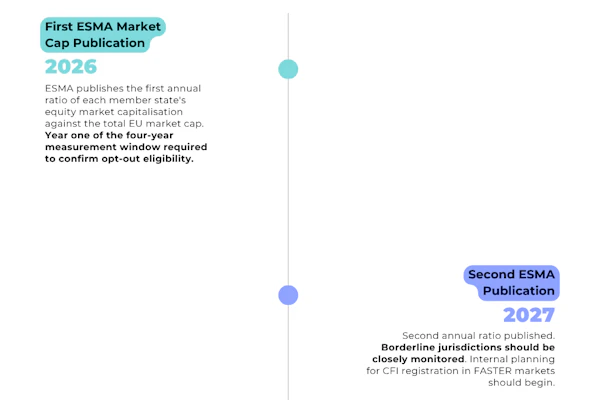
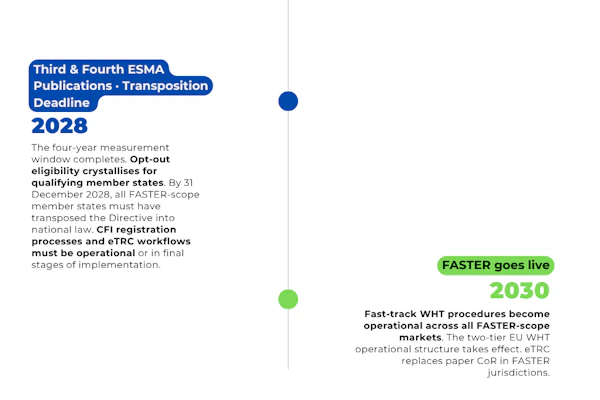
ESMA begins publishing the annual market cap ratios from 2026. Because four consecutive annual publications are required to confirm opt-out status, the earliest any member state can formally establish its eligibility is following the fourth publication: critical timing given the 31 December 2028 transposition deadline for the Directive itself.
Organisations should treat ESMA's annual publication schedule as a countdown clock. Any jurisdiction showing a ratio consistently below 1.5% should be monitored, as it may shift operational tier before or after 2030.
The 2030 Operational Split: FASTER Markets vs Opt-Out Markets
The practical result of the Regulation is a two-tier EU equity market structure from 1 January 2030. The table below sets out the expected configuration, based on current market capitalisation data and existing procedural frameworks.
| Member State | Expected Status | Operational Implications from 2030 |
|---|---|---|
| France | FASTER | eTRC replaces paper CoR; CFI framework; 60-day refund ceiling applies |
| Germany | FASTER | Largest EU equity market; full FASTER obligations; CFI registration required |
| Netherlands | FASTER | Fast-track procedures apply; existing relief-at-source regime will be aligned |
| Sweden | FASTER | FASTER obligations; eTRC workflow required |
| Spain | FASTER | Full FASTER market; current refund timelines replaced by 60-day maximum |
| Italy | FASTER | FASTER obligations apply; custodians acting as CFIs face new reporting duties |
| Denmark | FASTER (likely) | Market size indicates likely inclusion; ESMA publications to confirm |
| Estonia | Opt-Out | Existing bilateral treaty procedures and annual paper CoR cycles continue post-2030 |
| Latvia & Lithuania | Opt-Out | Current national refund frameworks remain in effect beyond 2030 |
| Malta & Cyprus | Opt-Out | Small market exemption; no CFI registration obligation |
| Austria | Monitor | ESMA publications from 2026–2028 will determine final tier assignment |
| Belgium | Monitor | Borderline case; existing BENELUX structures relevant to outcome |
| Greece & Portugal | Monitor | Market capitalisation fluctuates near threshold; annual ESMA data critical |
| Luxembourg | Monitor | Investment fund domicile rather than large equity exchange; opt-out possible |
The borderline cases (Austria, Belgium, Greece, Portugal, Luxembourg) represent the most operationally significant uncertainty between now and 2028. Their status cannot be confirmed until ESMA has published four consecutive annual ratios, meaning final clarity on these jurisdictions will only arrive in the months immediately before the transposition deadline.
What Changes Under FASTER and What Doesn't
In FASTER-scope markets
For jurisdictions that fall within FASTER's scope, the reform changes the procedural infrastructure for WHT relief at a fundamental level. The paper certificate of residence (CoR) — a cornerstone of most existing bilateral reclaim processes — is replaced by the eTRC: a digital, standardised tax residence certificate issued by member state tax authorities and transmitted electronically through CFIs.
Two relief pathways become available. Relief at source allows investors to receive dividends net of the correct treaty rate from the outset, rather than receiving a gross payment and recovering the excess. Where relief at source is not applied, the quick refund procedure must be completed within 60 days, replacing the highly variable national timelines that currently range from weeks to several years across EU jurisdictions. Custodian banks and fund administrators acting as CFIs are the entities responsible for due diligence, reporting, and liaising with member state tax authorities.
In opt-out markets
For members states that qualify under the 1.5% threshold, the FASTER architecture does not apply. The existing procedural landscape (bilateral tax treaty reclaims, paper CoR cycles, national refund timelines) continues beyond 2030 unchanged. Investors holding equities in Estonian, Maltese, or other opt-out markets will continue to navigate each jurisdiction's domestic procedures as they do today.
What FASTER does not replace
A critical point for institutional investors pursuing existing recovery strategies: FASTER does not supersede CJEU-based reclaim routes grounded in EU treaty law. Claims under Article 63 TFEU (the line of cases including the KEVA decision, which established that non-resident pension funds may be entitled to the same WHT treatment as comparable domestic funds) continue on their existing legal basis in parallel with the new FASTER procedures. The two frameworks operate independently.
Preparation Timeline: The 2026–2030 Window
Practical Steps for Institutional Investors and Custodians
Map your EU equity portfolio now against the confirmed FASTER / opt-out split and the list of jurisdictions to monitor via ESMA's annual publications.
Begin internal scoping for CFI registration in FASTER markets: France, Germany, Netherlands, Sweden, Spain, and Italy. The 2028 transposition deadline is closer than the 2030 go-live date implies.
Establish processes to receive and act on ESMA's annual market cap ratio publications from 2026 onwards. Borderline jurisdictions can shift tier before the 2028 deadline.
Assess existing eTRC infrastructure requirements: digital certificate workflows differ materially from paper CoR processes and will require system-level changes across custody and fund administration operations.
Confirm that existing CJEU-based reclaim strategies (including KEVA-line claims under Article 63 TFEU) remain live and are not disrupted by internal FASTER preparation work.
In opt-out markets (Estonia, Latvia, Lithuania, Malta, Cyprus, and others to be confirmed), existing bilateral treaty reclaim procedures remain in effect. No change to operational approach is required for these jurisdictions in anticipation of 2030.
The Bigger Picture
Delegated Regulation (EU) 2026/110 is secondary legislation, but its significance for operational planning is primary. The FASTER Directive created the framework, and this Regulation fills in the map.
For the first time since FASTER's adoption, institutional investors and their custodians can segment their EU equity portfolios with confidence: FASTER markets, opt-out markets, and a defined set of borderline cases to monitor over the next two years.
The 2026–2028 ESMA publication cycle is not just an administrative formality, but rather the mechanism by which the final operational architecture of EU WHT is being determined in real time. Organisations that begin CFI registration scoping, eTRC workflow design, and portfolio-level operational segmentation now will avoid the compressed pressure of acting in the months immediately before the 31 December 2028 transposition deadline.
__
The content published on this website is for general informational purposes only. While we strive to ensure the accuracy and timeliness of the information presented, no legal rights can be derived from the content. We do not accept any liability for errors, omissions, or inaccuracies in the information provided. The content does not constitute professional advice, and readers are strongly encouraged to consult a qualified advisor before making any decisions based on the information shared on this website.
Topics


